Behind every breakthrough in cancer research is a community of scientists sharing ideas, challenging assumptions and building on one another's discoveries.
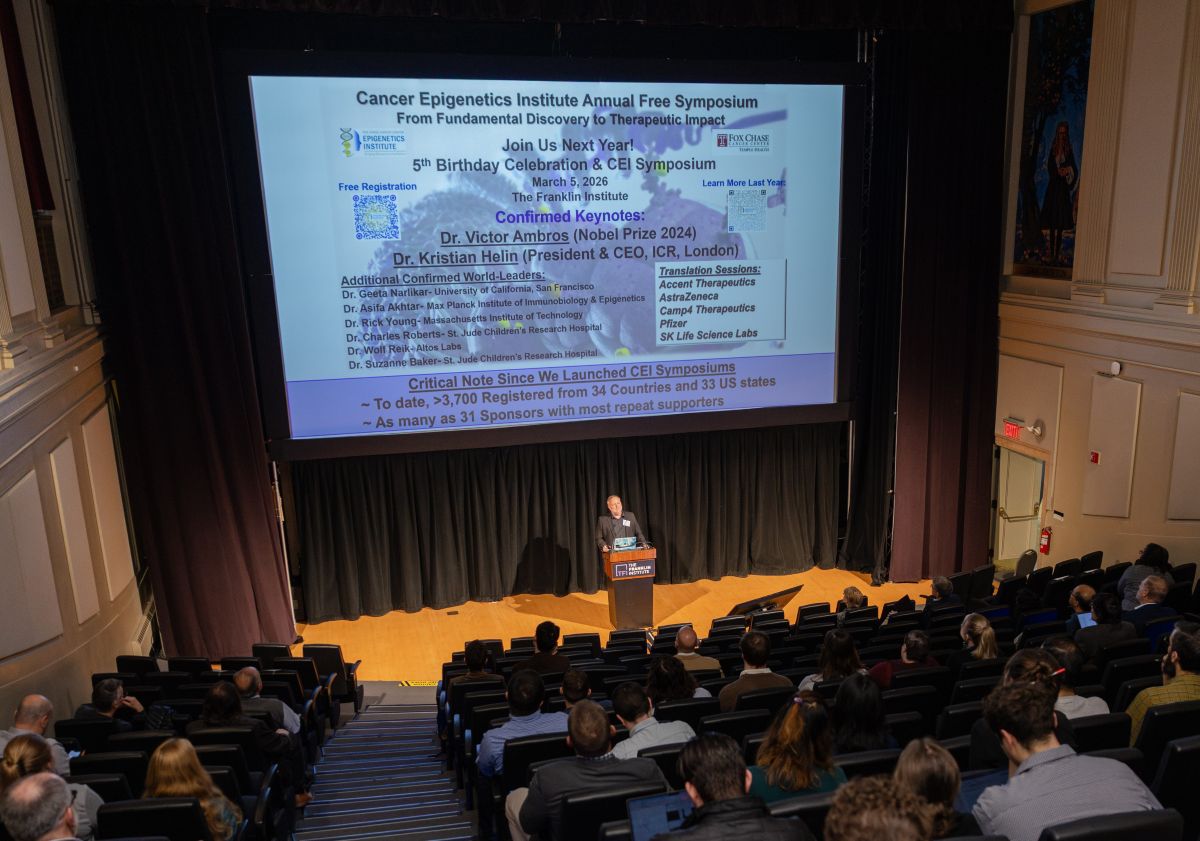
That was the idea behind Fox Chase Cancer Center’s sixth annual Cancer Epigenetics Institute (CEI) Symposium that celebrated the 5th birthday of CEI. The event brought together more than 750 scientists, clinicians, trainees and industry leaders from 20 countries to showcase the latest discoveries in epigenetics and their potential to improve cancer care.
Since its launch in 2021, the symposium has become an international forum where researchers share emerging science, exchange ideas and build collaborations that can accelerate progress against cancer. More than 3,700 participants from 33 states and 34 countries have attended over the past five years.
"Our goal is simple," said Johnathan Whetstine, PhD, Director of the Cancer Epigenetics Institute at Fox Chase. "Once a year, we want to bring world-class science to anyone, anywhere, at any educational level that want to learn—with no barriers."
Featuring Leaders in Cancer Epigenetics
This year's symposium featured keynote presentations from Victor Ambros, PhD, who received the 2024 Nobel Prize in Physiology or Medicine for co-discovering the first known microRNA, and Kristian Helin, MSc, PhD, President and CEO of The Institute of Cancer Research in London and an internationally recognized leader in cancer epigenetics.
Additional presentations from leading academic, biotechnology and pharmaceutical researchers explored topics including gene regulation, chromatin biology, three-dimensional genome organization and new therapeutic strategies aimed at improving cancer diagnosis and treatment.
Together, the sessions highlighted how advances in epigenetics are helping scientists better understand how tumors develop, evolve and respond to therapy.
A Meeting Built on Collaboration
While scientific presentations remain the centerpiece of the symposium, organizers say its greatest strength is bringing together researchers at every stage of their careers.
The event provides opportunities for faculty, trainees and early-career investigators to meet internationally recognized scientists, exchange ideas and build collaborations that often extend well beyond the annual meeting.
"The CEI has achieved international visibility in just five years largely due to Jonathan's vision and leadership," said Peter Jones, PhD, Chief Scientific Officer Emeritus at Van Andel Institute and a member of the CEI Advisory Board. "The symposium has become a must-attend event for the epigenetics community, balancing in-person and remote participation."
By offering the symposium free of charge and livestreaming sessions, the institute has expanded access to cutting-edge science for researchers around the world.
Looking Toward the Future
The symposium also offered a glimpse of what's ahead.
Planning is already underway for the 2027 meeting, which will feature keynote presentations by Robert Weinberg, PhD, recipient of the 2013 Breakthrough Prize in Life Sciences, and Steve McKnight, PhD, recipient of the 2025 Albert Lasker Basic Medical Research Award, along with internationally recognized researchers from academia and industry.
For Whetstine, the symposium's success is measured not only by attendance or scientific accomplishments, but by the relationships it helps create.
"Science moves forward through collaboration," he said. "Every conversation has the potential to spark a new idea, a new partnership or the next discovery that ultimately benefits patients."