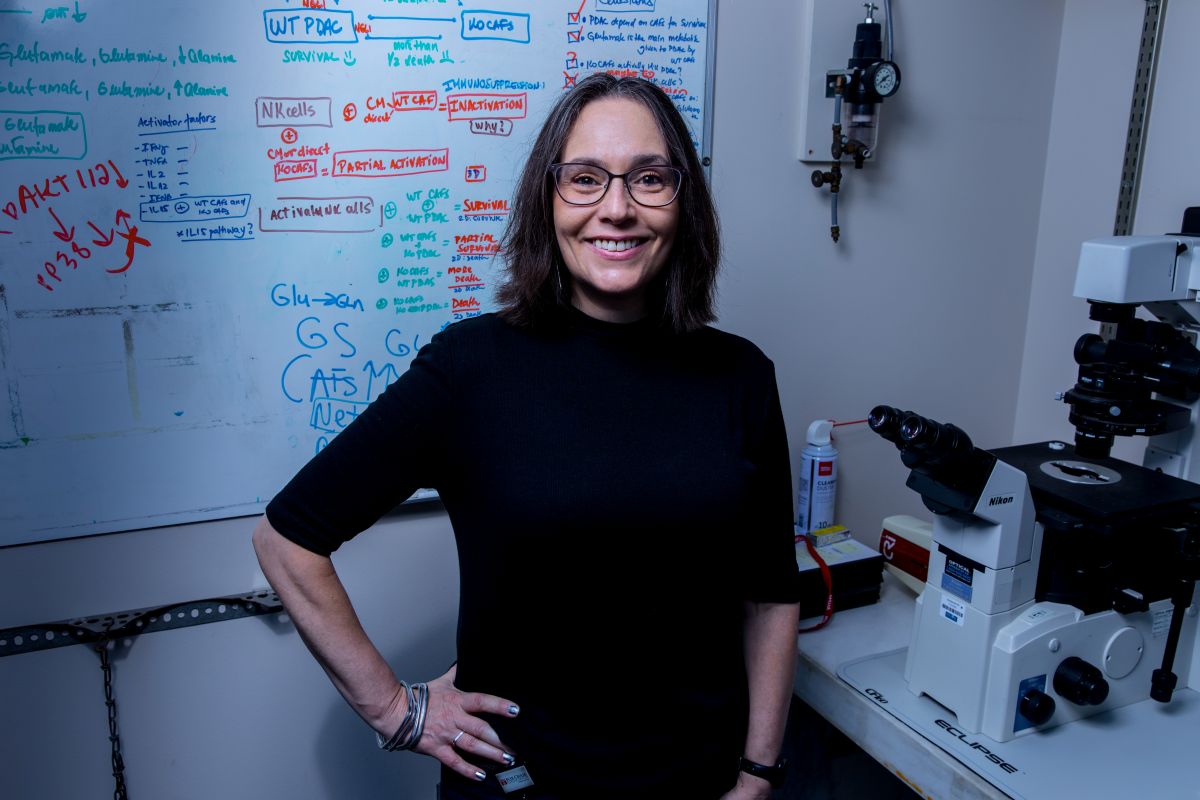
- Cukierman was appointed to the National Cancer Institute’s Working Group for Extramural Research Concepts, recognizing her leadership in tumor microenvironment research.
- Her 23-year career at Fox Chase Cancer Center has produced major discoveries that are now shaping new therapeutic approaches and informing clinical trials.
- Her multicultural upbringing and strong mentorship community have shaped her into a scientist whose work bridges basic biology, clinical translation, and national cancer policy.
PHILADELPHIA (December 22, 2025) — For Edna “Eti” Cukierman, PhD, science has always reached beyond borders — cultural, geographic, and disciplinary. Her path from Mexico to Israel to the United States, her rise from basic researcher to internationally recognized and clinically relevant cancer biologist, and her decades of leadership at Fox Chase Cancer Center have all prepared her for the newest and most public role of her career.
Cukierman was recently appointed to the National Cancer Institute’s (NCI) Working Group for Extramural Research Concepts, a prestigious advisory group that brings together 35 national experts to help shape the direction of federally supported cancer research.
Cukierman’s work has helped redefine understanding of the tumor microenvironment, the ecosystem around tumors that influences how cancers grow, spread, and respond to treatment. Her appointment is both a recognition of her scientific impact and an opportunity to elevate a field she has spent decades advancing.
I came to Fox Chase decades ago to establish my laboratory as a junior basic biology researcher, and Fox Chase allowed me to grow into a translational researcher focused on cancer who now contributes to how clinical trials are designed and analyzed. I’m happy that Fox Chase is being recognized through my appointment, and I’m honored to serve the public in this way,” Cukierman said.
As the Marvin and Concetta Greenberg Chair in Pancreatic Cancer Research, Co-Leader of the Cancer Signaling and Microenvironment Research Program, and Co-Director of the Marvin and Concetta Greenberg Pancreatic Cancer Institute, Cukierman is uniquely positioned to bring both scientific expertise and translational insight to her new national role.
A Multilingual, Multicultural Beginning
Cukierman’s story starts in Mexico, where she grew up in a multilingual home and attended a private Jewish school. There she learned Yiddish and Hebrew alongside her native Spanish; English would become her fourth language in high school. Still unsure of her career path after graduation, she took a gap year in Israel, where she met her husband.
She enrolled at the Technion-Israel Institute of Technology, earning degrees in biology, biochemistry, and molecular and cell biology. During her doctoral studies she published a landmark Science paper describing her discovery of ARF1-GAP, the first in what would become a whole family of ARF-GAP enzymes that regulate vesicle movement in cells.
These achievements alone would have been remarkable, but she accomplished them while raising two young sons. Balancing motherhood and doctoral research wasn’t easy, but she credits it with sharpening her focus. “Having kids early in my career forced me to prioritize,” she said. “It made me a better scientist.”
New Discoveries and New Directions
After completing her doctorate, Cukierman and her family moved to Bethesda, Maryland, where she conducted postdoctoral research at the National Institutes of Health. At the NIH, her curiosity led to another major Science publication, this time identifying a new adhesion structure between fibroblasts and their natural fibrous environment.
This discovery set the stage for the work that would define her career.
A New Frontier at Fox Chase Cancer Center
When Cukierman joined Fox Chase 23 years ago, she knew little about cancer biology. But she understood fibroblasts, cells that shape the architecture of tissues. She soon realized that these cells played a profound role in cancer development and progression.
Her laboratory has since made influential contributions to the study of the tumor microenvironment. Her pioneering work helped demonstrate how cancer-associated fibroblasts can either support or suppress the growth of tumors. One of her lab’s major discoveries, identifying Netrin-G1 as a potential therapeutic target, opened the door to new approaches for making pancreatic tumors more vulnerable to treatment.
These discoveries, once purely basic science, now guide clinical trials designed to modulate the microenvironment and enhance patient outcomes. Seeing her team’s work move toward patient care has been especially meaningful. The hope, she said, is to bring real benefits to patients with pancreatic and other hard-to-treat cancers.
A Career Built on Mentorship and Community
Cukierman attributes much of her success to the Fox Chase community. She draws inspiration from legendary Fox Chase scientists such as Beatrice Mintz, PhD, and Alfred Knudson, MD, PhD, who taught her how noncancerous cells and natural tumor-suppressive genes shape tumor development. More recent mentors have influenced her approach to collaboration, leadership, and scientific rigor.
Today she serves as a mentor herself, guiding early-career investigators just as generously as others guided her.
Stepping Into a National Leadership Role
Cukierman’s recent appointment to the NCI Working Group comes at a pivotal time for cancer research. The group’s charge is to provide independent guidance on the direction of extramural research programs, ensuring that federal funding supports innovative, high-impact science. Her expertise in tumor-tissue interactions, translational research, and microenvironment-driven therapies brings a vital perspective to the national conversation.
For a researcher shaped by multiple cultures, languages, and scientific traditions, joining the NCI Working Group feels like a natural next step. It is a moment that honors her decades of discovery while giving her a platform to help shape the future of cancer research nationwide.
Her story — a blend of global perspective, scientific rigor, and family partnership — continues to expand in impact, now reaching from her Fox Chase laboratory to the highest levels of national cancer research leadership.