Contrast-Enhanced Mammography (CEM): A Clearer Look at Breast Cancer Screening
-
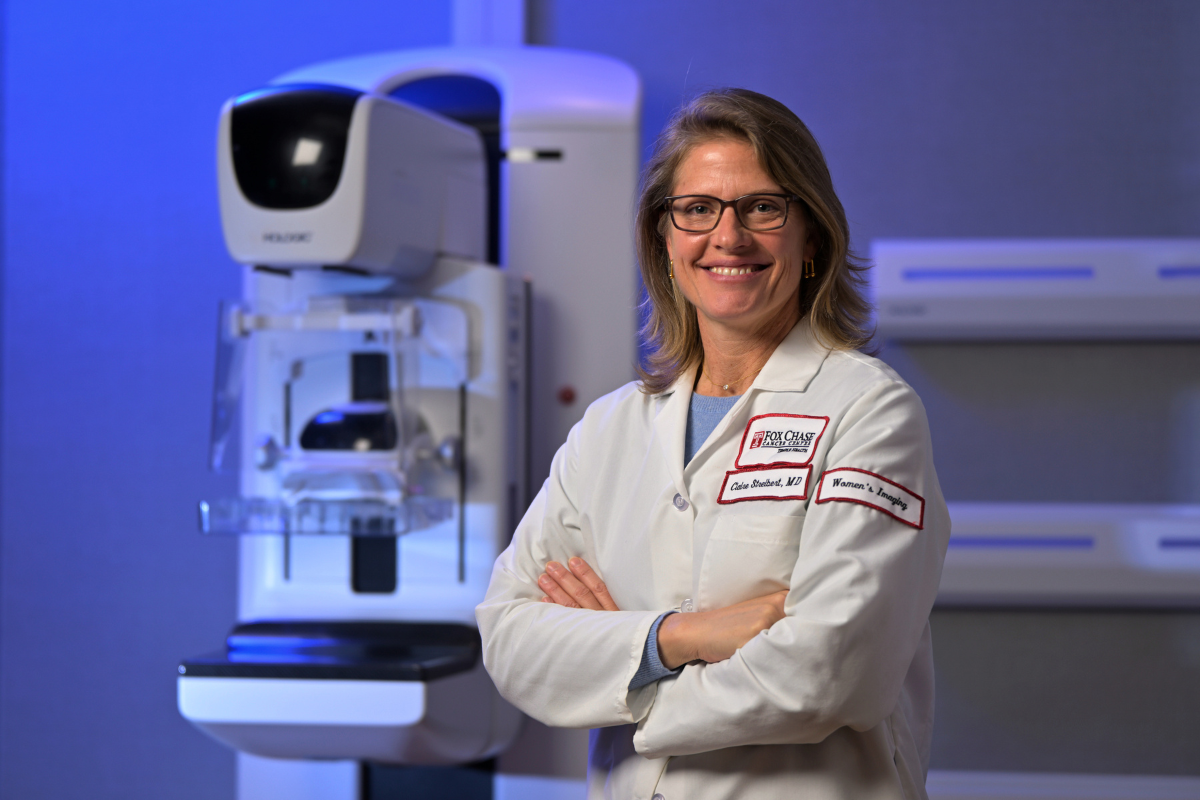
By Claire L. Streibert, MD, Chief, Breast Imaging, Fox Chase Cancer Center
As a breast radiologist, I know how valuable regular mammograms are for finding breast cancer early — when it’s often easier to treat. For some patients, other imaging tests can help, too. One option is contrast-enhanced mammography (CEM).
CEM is a new service at Fox Chase. It combines a mammogram with an added element: A small amount of iodine-based dye given through an IV. In the right situation, the dye helps certain cancers stand out more clearly than they do on a standard mammogram. This can be especially helpful for women with dense breasts or a higher risk of breast cancer.
Not every patient I see has heard of CEM, so I often bring it up when we talk about screening. Here’s what we discuss — and how you can decide whether CEM may be a good option for you.
Contrast-enhanced mammography: The basics
CEM is an advanced breast imaging test. It feels a lot like a regular mammogram. One key difference: before we take the pictures, you get a small IV injection of iodine-based dye. The dye highlights areas with increased blood flow. Some cancers create new blood vessels, so these areas may show up more clearly.
With this added contrast, CEM can find some cancers that may be harder to see on a standard mammogram, especially in dense breast tissue. Like any test, it can still lead to follow-up imaging or a biopsy. Studies show CEM can work about as well as breast MRI in many cases when we need a closer look. In some studies, it also leads to fewer false alarms.
CEM can also play a key role after a breast cancer diagnosis. The enhanced images can help show the size of the tumor and whether there may be more than one area involved. This can support treatment planning and help us see how treatment is working.
Some patients ask whether CEM is the same as a 3D mammogram — great question. A 3D mammogram (tomosynthesis) takes many low-dose x-ray pictures from different angles and builds a 3D view. CEM uses dye to help certain areas stand out. It usually creates 2D images, not a 3D picture. With CEM, the goal is clearer detail.
CEM vs. standard mammography and MRI
When I’m discussing CEM with patients, many ask about how it stacks up to other, better-known screening options.
Standard mammography finds many breast cancers, but it can miss some — especially in dense breasts, where normal tissue can hide small tumors. Studies show CEM can find more cancers than standard mammography alone. In many settings, CEM performs similarly to breast MRI.
Breast MRI is still one of the best tests for finding small cancers in people at high risk. But CEM can be a strong option when MRI isn’t a good fit. It is usually faster and more comfortable. And it’s done in the mammography suite. CEM uses iodine-based dye, not the dye used for MRI. That’s why it may be an option for some patients who cannot receive MRI contrast. It may also help patients who cannot tolerate MRI because of severe claustrophobia or certain implanted devices.
How quickly you get results depends on the reason for the test and the imaging center. In many cases, diagnostic CEM results are reviewed with you during your visit (similar to other diagnostic mammograms), so you can leave with clear next steps.
Understanding your breast cancer screening options
Most medical groups recommend starting regular mammograms around age 40 for women at average risk. Some recommend screening every year, while others recommend every other year. Your personal risk and family history matter, so talk with your healthcare provider about the schedule that makes the most sense for you.
Some women may benefit from more advanced screening options, like CEM, including those who:
- Are at high risk for breast cancer and cannot have a screening MRI
- Have dense breast tissue and are at increased risk for breast cancer
- Have a personal history of breast cancer and were treated with breast-conserving surgery that left post-surgical scars
In the United States, CEM is FDA-approved for diagnostic breast imaging. This means it is used to take a closer look when a standard mammogram is unclear or when someone has symptoms such as a lump or nipple discharge.
Researchers are still studying CEM as a routine screening test. Using it for screening is considered “off-label.” In other words, it is not officially approved for screening yet. Still, some professional groups support it as an option for women who need MRI screening but can’t have an MRI.
While CEM is a powerful tool, it isn’t necessarily right for everyone. That’s why I encourage women to talk with their healthcare providers. Together, you can decide on a screening plan that makes sense for you.
What to expect at your CEM appointment
It’s normal to wonder what your CEM will be like if you’re coming in for the first time. Here’s how things will go, plus how to prep ahead of time.
Beforehand
Just like with a standard mammogram, avoid putting on any deodorant, lotion, cream, powder, talc, oils, or fragrances under your arms or on your breasts on the day of your CEM. These can interfere with the images. You may eat and drink normally before your exam, no fasting needed. That said, the contrast can make some people feel a little queasy, so I usually suggest a light meal beforehand, like fruit, toast, a small sandwich, or a bowl of soup.
Also, plan for a bit more time than a standard mammogram. Many CEM appointments take longer because we need to place an IV, review your health history (including kidney function and past contrast reactions), and watch you briefly after the injection.
During
Before your scan, an IV will be placed in your arm to inject the contrast dye. After the injection, your care team will observe you for a short period to make sure you feel okay. Some people notice a warm feeling or a metallic taste in their mouth immediately after the contrast is injected—this is common and typically lasts only a few minutes.
Once the dye is injected, you’ll undergo the actual imaging process. It’s just like a regular mammogram, where your provider takes images while your breast is compressed between two plates.
After
Drink extra fluids during the day after your CEM. Staying hydrated helps your body clear the dye.
Allergic reactions are uncommon, but they can happen. Most happen right away, but a rash or hives can show up later - sometimes even several hours after the exam. Call your care team if you develop symptoms. Seek emergency help right away if you have trouble breathing, swelling of the face or throat, or feel faint.
At the end of the day, the goal is simple: clearer answers and a clear plan. Whether everything looks reassuring or we need a closer look, you’ll leave knowing what the images show and what happens next.
Make your personal screening plan
Breast cancer screening is an important part of your overall preventive care. Temple Health and Fox Chase offer advanced breast imaging options and personalized screening plans to meet your needs. To learn more, call 888-369-2427 or request an appointment online today.
Helpful Resources
Looking for more information?