

Breast Cancer Research in Action: Three Fox Chase Studies Are Shaping What’s Next
-
August 18 is World Breast Cancer Research Day — a date chosen to reflect the approximately 1 in 8 women who will develop breast cancer during their lifetime. At Fox Chase Cancer Center, researchers are working to improve not only how breast cancer is treated, but also how treatment affects patients during and after their care.
Breast cancer research can take many forms.
It can mean testing a new medication that may help prevent cancer from returning. It can mean asking whether some patients can safely undergo less extensive surgery and experience fewer long-term side effects. And it can mean studying more than a million patients to better understand how the timing of treatment may affect cancer growth and progression.
Those questions are at the center of three important areas of breast cancer research involving Fox Chase Cancer Center investigators.
The ELEGANT clinical trial, led locally by breast medical oncologist Joyce Habib, MD, is evaluating a different endocrine therapy for patients at higher risk of recurrence.
The NOAX clinical trial, led locally by breast surgical oncologist Austin Williams, MD, MSEd, FACS, is studying whether a more targeted approach to lymph node surgery can reduce long-term side effects.
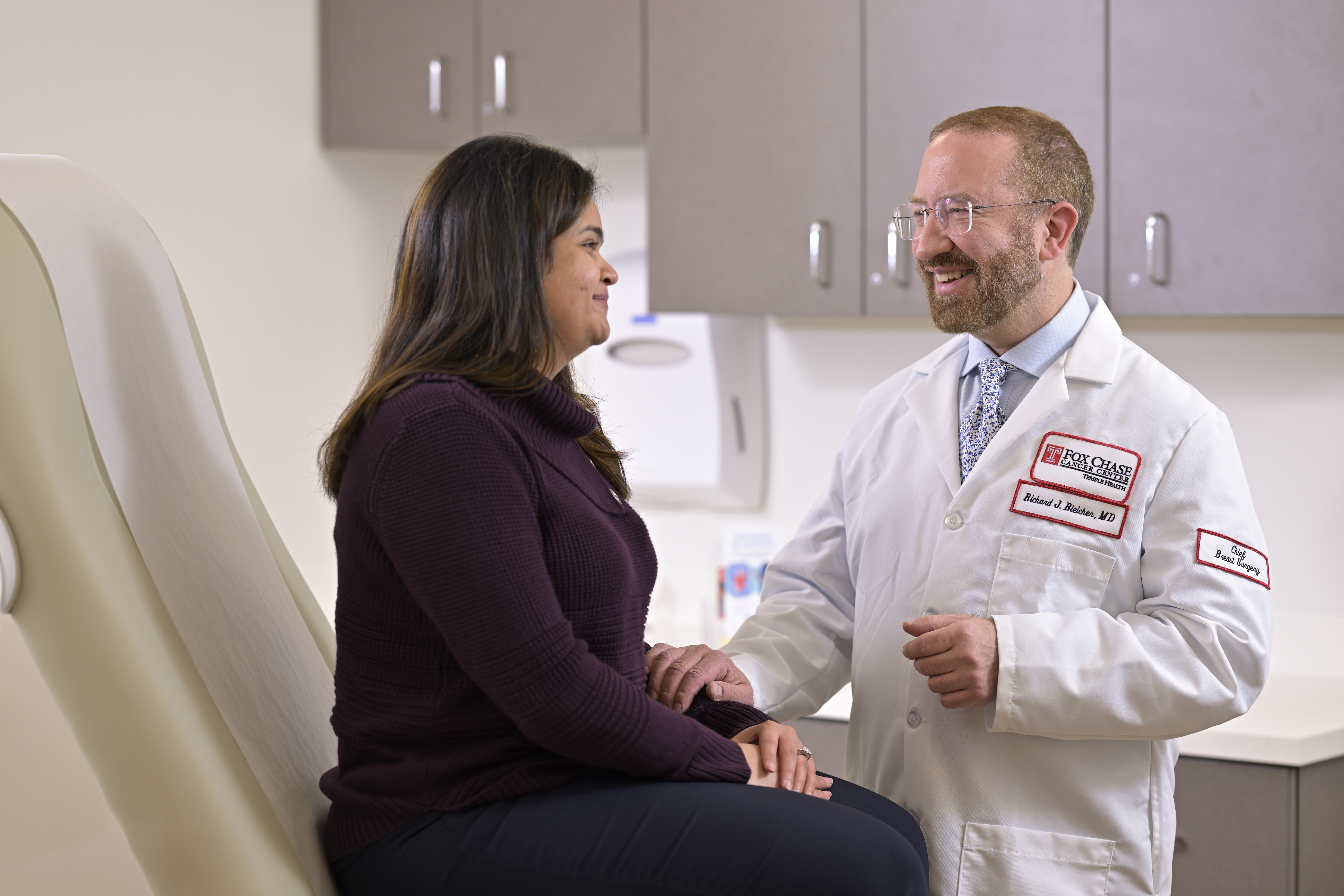
And a large Fox Chase-led study by breast surgical oncologist Richard J. Bleicher, MD, is providing new information about breast cancer growth, upstaging, and the potential impact of delays between diagnosis and surgery.
Together, the studies demonstrate how research can shape breast cancer care from several directions — finding better treatments, reducing unnecessary treatment burden, and helping physicians make more informed decisions about when care should occur.
ELEGANT: Looking for a Better Way to Prevent Breast Cancer Recurrence
For many people with estrogen receptor-positive, HER2-negative breast cancer, endocrine — or hormone-blocking — therapy plays an important role in preventing cancer from returning after initial treatment.
But some patients remain at higher risk of recurrence, particularly when cancer has involved the lymph nodes.The ELEGANT study is examining whether a medication called elacestrant may offer another option for patients with node-positive, estrogen receptor-positive, HER2-negative early breast cancer who remain at high risk for recurrence.
Researchers are comparing elacestrant with standard endocrine therapy to determine which approach is more effective at helping prevent invasive breast cancer from returning.
That question is important because breast cancer treatment does not necessarily end when surgery, chemotherapy, or radiation is completed. For patients with hormone-sensitive cancers, endocrine therapy may continue for years, and reducing the risk of recurrence remains a major part of long-term care.
-
For patients with early-stage breast cancer, one of our biggest goals is not only treating the cancer we know is there, but reducing the risk that it ever comes back. The ELEGANT trial gives us an opportunity to ask whether we can improve upon the endocrine therapies we already use for patients who remain at higher risk of recurrence. World Breast Cancer Research Day is an important reminder that every advance in treatment begins with patients and researchers willing to ask whether we can do better.
ELEGANT also reflects the growing shift toward personalized breast cancer care. By tailoring the escalation of adjuvant endocrine therapy to a tumor's individual risk profile, physicians can choose treatments matched to each specific cancer - and clinical trials help researchers keep refining those decisions.Joyce Habib, MD -
NOAX: Can Breast Cancer Surgery Cause Less Long-Term Harm?
The NOAX trial approaches innovation from a different direction.
When breast cancer has spread to lymph nodes in the underarm, some patients undergoing surgery require an axillary lymph node dissection, which removes multiple lymph nodes to address cancer in the axilla.
While the procedure can be an important part of treatment, it can also cause lasting side effects, including lymphedema, numbness, discomfort, and reduced shoulder or arm mobility.
The international NOAX trial is investigating whether some patients with lymph node-positive breast cancer undergoing surgery upfront could instead benefit from a more targeted approach.
Researchers are comparing standard axillary lymph node dissection with a combination of tailored axillary surgery and axillary radiation therapy.
Tailored axillary surgery focuses on selectively removing lymph nodes known or suspected to contain cancer rather than routinely removing the larger group of lymph nodes taken during a complete axillary dissection.
The central question is highly patient-focused: Can this approach improve arm-related quality of life and reduce lymphedema two years after treatment?
-
As surgeons, we always have to ask whether every part of the treatment we traditionally perform is necessary for every patient,” Williams said. “The NOAX trial is studying whether we can treat cancer in the lymph nodes while reducing some of the long-term effects associated with more extensive surgery. Research like this matters because success in breast cancer care is not measured only by treating the disease. We also want our patients to live as well as possible after treatment.
Austin Williams, MD, MSED, FACS -
Understanding What Happens When Breast Cancer Treatment Is Delayed
Another important area of research at Fox Chase is helping answer one of the most common questions patients ask after a breast cancer diagnosis:
How quickly does my cancer need to be treated?
A Fox Chase-led study published in Annals of Surgical Oncology examined data from more than 1 million patients with nonmetastatic breast cancer treated between 2010 and 2020 who underwent surgery as their first treatment. Researchers evaluated whether longer intervals between diagnosis and surgery were associated with tumor growth, advancement to a higher tumor stage, or spread to the lymph nodes.
The study found that the likelihood of tumor upstaging increased as the time between diagnosis and surgery grew. For each additional 30 days, the adjusted odds of tumor upstaging increased by approximately 11% for ductal carcinoma in situ, 13% for clinical T1 tumors, and 18% for clinical T2 tumors. The odds of a patient who initially appeared to have lymph node-negative disease being found to have node-positive disease also increased with longer delays.
Researchers also found that the impact of delay was not the same for every breast cancer. Triple-negative breast cancers showed both a greater likelihood of upstaging and faster estimated growth than hormone receptor-positive or HER2-positive tumors. Larger tumors also tended to grow more quickly than smaller tumors.
The findings help provide data behind something physicians have long believed: while breast cancers generally do not change dramatically overnight, prolonged delays can allow some cancers additional opportunity to grow or spread.
At the same time, the researchers emphasize that many breast cancers grow relatively slowly and that not every period between diagnosis and treatment represents a harmful delay. Appropriate imaging, biopsies, multidisciplinary evaluation, surgical planning, and second opinions may all be important parts of developing the right treatment plan. The value of the research is that it helps physicians better understand and quantify the risks associated with increasing delays, rather than leaving patients to wonder how quickly their cancer may be changing.
-
One of the questions patients ask us most often after a breast cancer diagnosis is whether waiting for treatment will allow their cancer to grow or spread. This research gives us better information to help answer that question and shows why timely care matters, particularly for patients with larger tumors or triple-negative breast cancer. World Breast Cancer Research Day is also an opportunity to recognize that research is not only about finding new drugs or procedures — it is about answering the practical questions patients and physicians face every day and using that evidence to continually improve care.
Richard Bleicher, MD, FACS -
Research Can Mean More Treatment — or Less
Although these three projects address very different questions, they share the same goal: making breast cancer care better for the individual patient.
Sometimes progress means identifying a treatment that may further reduce the risk of recurrence.
Sometimes it means determining whether a patient can safely receive less extensive treatment and experience fewer long-term side effects.
And sometimes it means generating better evidence to help physicians and patients understand how quickly treatment should move forward.
That is why clinical research is not limited to patients with advanced cancer or people who have exhausted standard treatments. Breast cancer research takes place across the entire continuum of care — from early-stage disease and surgery to medications, radiation, prevention, survivorship, quality of life, and healthcare delivery.
Why Breast Cancer Research Matters Every Day
World Breast Cancer Research Day brings attention to the work that makes continued progress in breast cancer care possible.
At Fox Chase, that work involves breast surgeons, medical oncologists, radiation oncologists, scientists, biostatisticians, nurses, clinical research professionals, and, critically, the patients who participate in research.
Some studies may eventually change the medications patients receive. Others may change the way surgery is performed. Still others can provide physicians with evidence that helps them make better decisions every day.
The answers do not come overnight. But today’s research can become tomorrow’s standard of care.
For patients, that means more personalized treatment, fewer unnecessary side effects, better-informed decisions, and continued progress toward improving both outcomes and quality of life.
Learn More About Breast Cancer Research at Fox Chase
Patients interested in learning whether a clinical trial may be appropriate for them should speak with their care team. Fox Chase offers breast cancer clinical trials evaluating new medications, surgical strategies, and other approaches designed to improve treatment and quality of life.
To learn more about breast cancer care or clinical trials at Fox Chase Cancer Center, visit FoxChase.org or call 888-FOX-CHASE (888-369-2427).