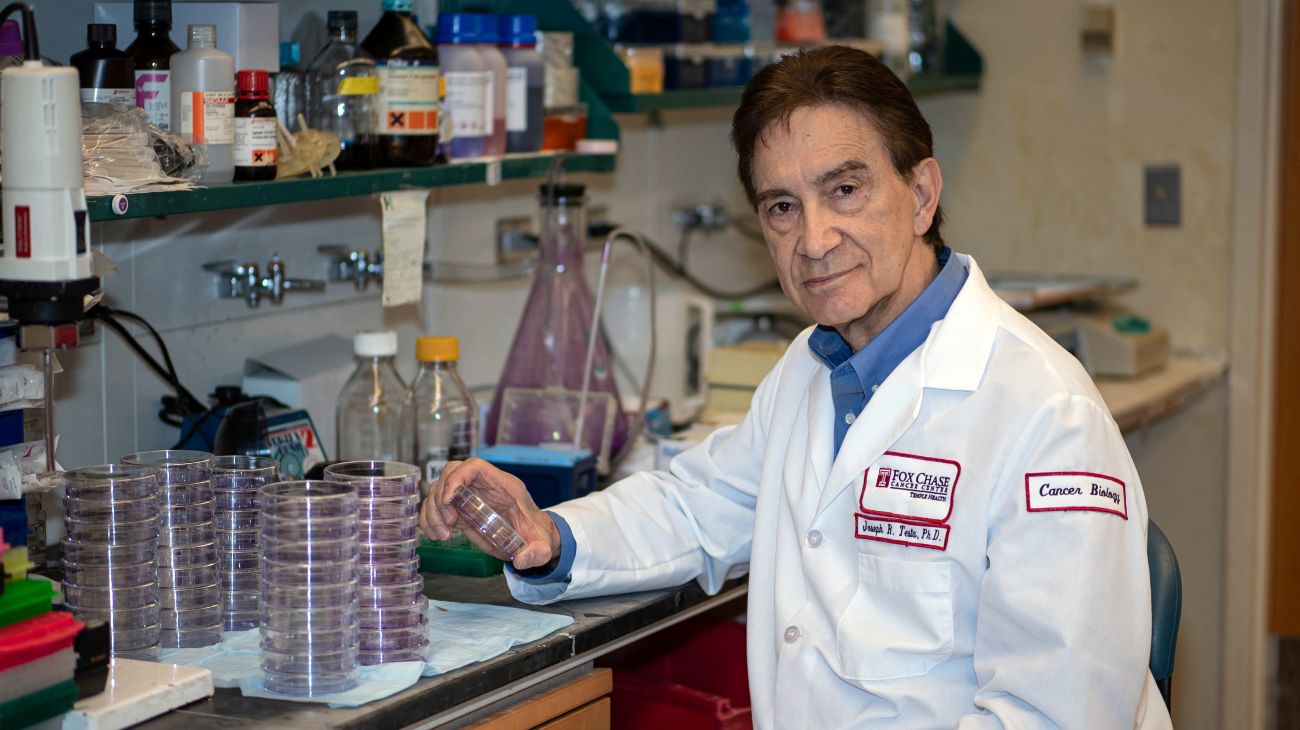
A collaborative study led, in part, by faculty from Fox Chase Cancer Center–Temple Health has identified a rare type of ovarian tumor as part of the cancer spectrum linked to an inherited condition that increases a person’s risk for several cancers.
Published in npj Precision Oncology, a journal published by Nature, the findings combine clinical observations from women with inherited mutations of BAP1-tumor predisposition syndrome, also known as BAP1-TPDS, with evidence from genetically engineered mouse models. Together, the results suggest that ovarian sex cord-stromal tumors (OSCST) should be recognized as part of this inherited cancer syndrome.
“For families affected by inherited BAP1 mutations, understanding the full range of cancer risks is essential,” said Joseph R. Testa, PhD, FACMG, the Carol & Kenneth E. Weg Chair in Human Genetics and Chief of Genomic Medicine at Fox Chase Cancer Center, who co-led the study. “Our findings indicate that these rare ovarian tumors should be considered part of the BAP1-tumor predisposition syndrome. That knowledge can help guide future discussions about monitoring, early detection, and research into better treatments.”
Understanding BAP1-TPDS
BAP1-TPDS, co-discovered by Testa’s lab in 2011, is caused by inherited mutations in the BAP1 tumor suppressor gene. Tumor suppressor genes normally help keep cell growth under control. When one copy of a gene is altered from birth, the risk of certain cancers is greatly increased.
People with inherited BAP1 mutations are known to have a higher risk of several cancers, including malignant mesothelioma, uveal melanoma, cutaneous melanoma, clear cell renal cell carcinoma, basal cell carcinoma, and, less commonly, tumors such as meningiomas.
The newly published study, titled “Ovarian sex cord-stromal tumors are part of the BAP1-tumor predisposition syndrome: evidence from human carriers and mouse models,” adds rare OSCST to that list.
Clues from Patients and Mouse Models
The possible connection between BAP1 and ovarian tumors was first reported in 2016, when researchers at Fox Chase found a high rate of OSCSTs in genetically engineered mice carrying inherited BAP1 mutations. In 2023, investigators in Australia reported an OSCST in a patient with an inherited BAP1 mutation, providing early evidence that the mouse findings might also be relevant to people.
The new study builds on those observations using clinical data from female BAP1 mutation carriers evaluated at The Ohio State University and Memorial Sloan Kettering Cancer Center, along with updated findings from mouse models developed and studied at Fox Chase.
Among 176 female BAP1 mutation carriers, 8 patients, or 4.5%, had ovarian cancer. Four of these patients had OSCSTs, which are rare in the general population.
Stronger Evidence for a BAP1 Link
Expanded mouse studies further strengthened the association. OSCSTs developed in several mouse strains carrying inherited BAP1 mutations, with rates ranging from 32% to 73%. By comparison, none of the 108 genetically normal female littermates developed these tumors.
The researchers also found loss or inactivation of both functional copies of the BAP1 gene in every tumor that could be evaluated, including three of three human OSCSTs and 10 of 10 mouse OSCSTs. This supports BAP1’s role as a tumor suppressor in ovarian tumor development.
“This study illustrates how genetically engineered mouse models can uncover previously unrecognized manifestations of inherited cancer syndromes,” said co-lead author Yuwaraj Kadariya, MD, PhD, an assistant research professor in Testa’s lab, who performed the mouse experiments. “The convergence of findings from mouse models and patients provides strong evidence that ovarian sex cord-stromal tumors belong within the BAP1-TPDS tumor spectrum.”
Implications for Care and Research
The study authors said the findings provide a biological rationale for considering ovarian surveillance in the clinical management of women with BAP1-TPDS. The work also lays the foundation for future studies aimed at developing mechanism-based therapies for these rare ovarian tumors.
In addition to Testa, collaborators from The Ohio State University and Memorial Sloan Kettering Cancer Center participated in this research.
Read the full paper here: Ovarian sex cord-stromal tumors are part of the BAP1-tumor predisposition syndrome: evidence from human carriers and mouse models