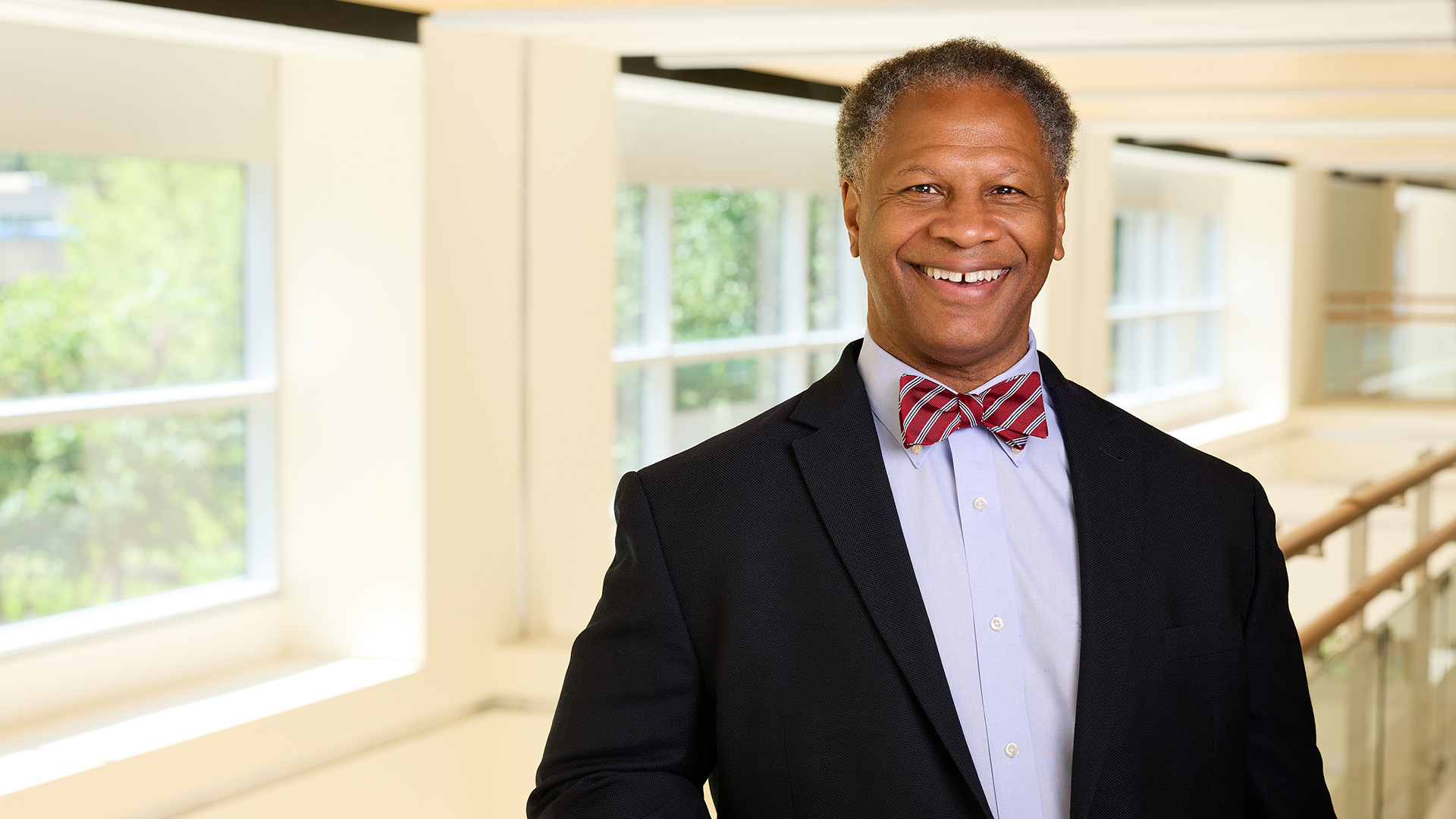
How would you describe your personal story and how you got here today?
I always tell people that my story is one of hope. And the reason I say that is because I was not meant to be a doctor, and I certainly was not meant to be a scientist. I am the product of what happens when people – particularly people from distressed communities – have access to opportunities to learn and explore their interests.
For me, the first opportunity was Head Start. Head Start is a program that started in the 1960’s to give kids like me – I’m the product of a teenage mom – the chance to start learning how to read early. That set me on the right path.
I’m also the product of great people. I give a lot of credit to not just my family for supporting me, but people like Father Austin and Father Walter, two priests at the University of Notre Dame, who were the first to see something in me. They encouraged me to pursue medicine.
So, I’m not so much a self-made man as I am a man made and created by the community that existed around me and lifted me up.
When did you first realize that medicine – and eventually cancer research – was truly your path?
If you asked me what I wanted to be when I was in high school, it was to be the youngest foreman at GM. Why? GM paid well and they made great cars.
I started off in the engineering program at the University of Notre Dame. Father Austin and Father Walter came to me and said, “Son, you’re no engineer.” Initially I had some hesitation. But they saw something in me before I could see it in myself. So I believed them. I rolled the dice and enrolled in pre-med classes. From there, I was accepted to the University of Michigan Medical School and met Dr. Francis Collins, who understood my desire to not only go into medicine, but to give back to my community in a meaningful way. He influenced me to also pursue research.
Later, at the University of Colorado, there was a small group of people who were inspired by the fight against lung cancer. At that point, we couldn’t screen for it and there was only one drug to treat it, which wasn’t great. Many had given up. But this group of amazing people were saying, “Let’s tackle this problem.” They had hope that progress could be made. That was a defining moment for me. I knew then that I was on the right path.
How has your background shaped the kind of cancer leader you’ve become?
To me, science is, of course, about creating new knowledge – cutting-edge, innovative discoveries. That’s a really fun part of what I get to do. But it’s also about bringing the science to my patients and, beyond that, making sure that communities outside of my patient rooms and my clinics also get access. At the end of the day, that is what’s going to make the biggest impact and is what I’m most passionate about--bringing science from bench to bedside and to the block.
When I say my story is one of hope, I really mean it. I have hope that I can lead well, that I can make a difference, and that we can find cures. Look at what we’ve done in lung cancer. When I was back doing research at the University of Colorado, the five-year survival rate for patients diagnosed with lung cancer was 10 or 12 percent. It’s near 30 percent now. And that’s just in my lifetime.
I’ve gotten a front-row seat to not theoretically seeing the importance of science, but literally seeing that the research we do can grow to scale and have not just positive clinical outcomes, but real and lasting impact in communities. That is what makes me tick as a leader.
What drew you to Fox Chase at this moment in your career?
First and foremost, it’s mission. In conversations I’ve had with folks here, they say, “We don’t just do science for science’s sake.” At Fox Chase, we do science because we really want to make sure people benefit from our science and can live healthier, better lives.
Second was the communities serviced by Fox Chase and the broader Temple system. The area that we have the privilege of being able to serve – and I mean that, the privilege of being able to serve – is outstanding. The need here is significant. But, if we do it right, so is the upside. People in our communities can get better and their life expectancy can improve. We can save lives. The fact that we’re a part of that is ridiculously amazing.
Lastly, it was an incredible team. Scientists, researchers, clinicians, administrators – everyone is exceptional. There’s a shared excitement around more closely aligning Fox Chase with broader Temple Health services. We want to become one house with one purpose: to kick cancer’s butt. For me, that feeling is palpable.
So when the opportunity came to join this institution, I didn’t even have to think about it for two seconds. It was an immediate yes. I said, “OK, let’s go. If you’ll have me, let’s go.”