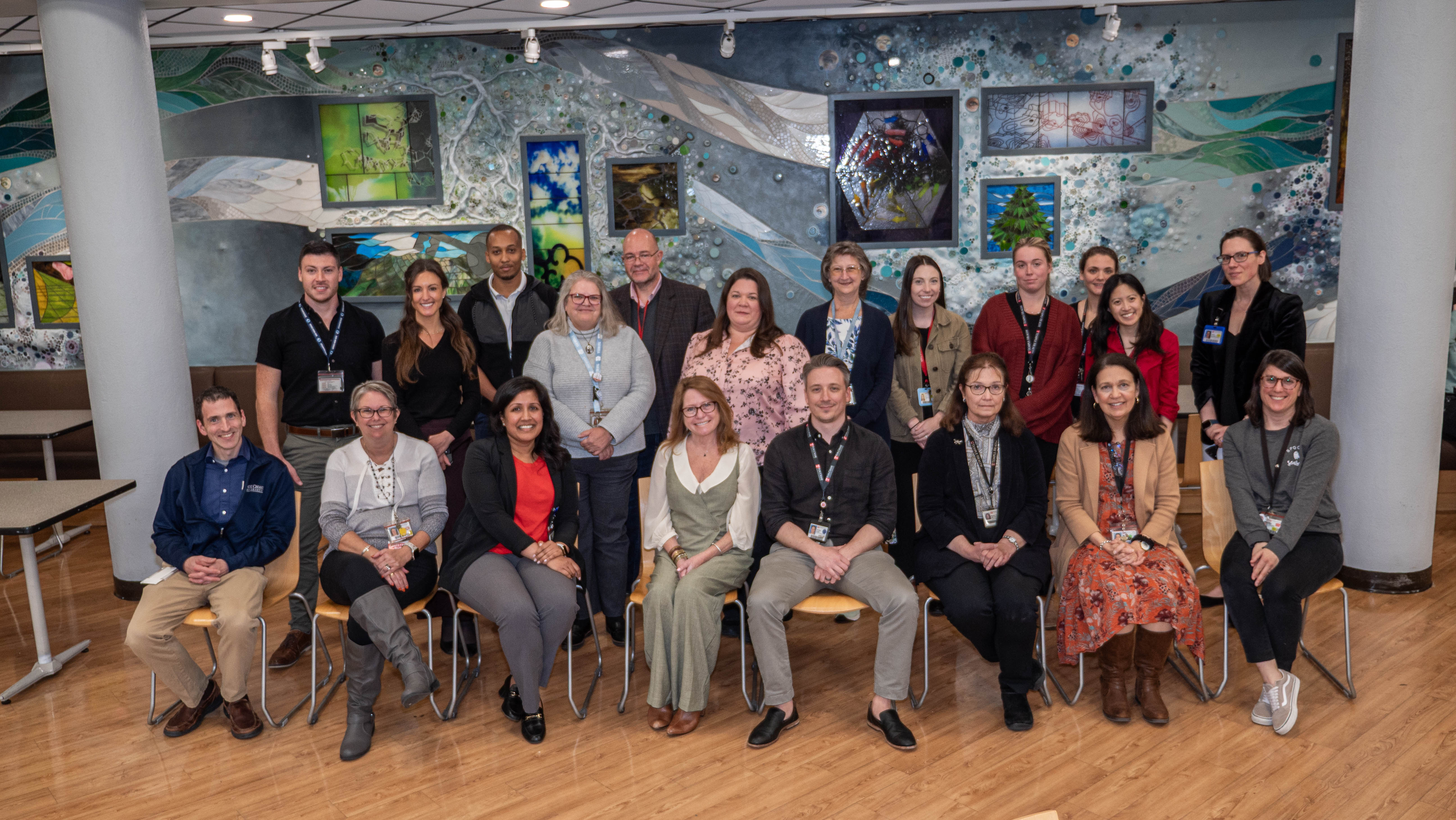
Faculty leaders and members of the Office of Clinical Research at Fox Chase Cancer Center
Teatime at Fox Chase Cancer Center is a sacred campus institution and a fitting time to celebrate milestones. On October 28, 2025, Fox Chase hosted a Special Tea event to celebrate the reaccreditation of its Human Research Protection Program (HRPP) by the Association for the Accreditation of Human Research Protection Programs, Inc. (AAHRPP). This is Fox Chase’s sixth consecutive accreditation since first achieving the distinction in 2004, merely two years after the AAHRPP launched the program.
AAHRPP accreditation is recognized nationally and internationally as the gold standard for human research protection. The recognition affirms Fox Chase’s longstanding commitment to protecting research participants and upholding the highest ethical, patient-centered research standards.
Safeguarding Patients With the Highest Degree of Integrity
“Safety is paramount, and our accreditation is a testament to the rigor and care that define our approach,” said Glenn Rall, PhD, Professor and Chief Academic Officer at Fox Chase, who spoke at the event. “Maintaining this standard is challenging, but we owe it to our patients to uphold the highest level of protection and integrity.”
The accreditation, says Rall, is not just vital for protecting patients who participate in trials, but also an essential component of the institution’s ability to attract research sponsors, academic partners, and scientists to the faculty. Rall lauded the Office of Clinical Research for making the reaccreditation possible, particularly the “Herculean” efforts of Sophia Sabina, MBA, Director of the Institutional Review Board (IRB), and Victoria Sabella, BSN, CCRC, CIP, now-retired Director of Research Compliance and Integrity, who led the preparation of the submission and coordinated site visits.
Better Recruitment, Safer Trials, and Greater Impact
“As someone who engages with the day-to-day operations of our clinical research enterprise, I can share firsthand that AAHRPP reaccreditation is not a one-time event,” said Teena Kochukoshy, MD, DBA, AVP of the Office of Clinical Research. “This is the result of consistent, daily dedication across every part of our research community.”
According to Kochukoshy, reaccreditation translates into better recruitment, safer trials, and greater impact for Fox Chase investigators. She also emphasized the effect on trial participants. “In caring for patients, every informed consent discussion, every protocol review, every quality check is part of a much bigger story—one about the respect and trust that we nurture in the conduct of clinical research,” she said.
To maintain accreditation status, the AAHRPP requires a complex review every five years. According to Sabina, each re-application is extensive. It begins with a benchmark assessment, a thorough written analysis of the entire program, and a detailed review of documentation, including Standard Operating Procedures (SOPs), reporting procedures, IRB minutes, and evidence of compliance across all scientific areas. The review culminates in a multi-day site visit—on-site or remote—during which AAHRPP evaluators interview leadership, IRB members, and key personnel while closely examining selected studies and procedures.
Validated Through a Peer-Driven Process
“It is a peer-driven process, so AAHRPP will assign people who participate in IRBs at other institutions to come in, review the documents, and ask questions,” said Sabina. “It represented many late evenings and weekends—not just for Vicki and me, but for the entire team in the Office of Clinical Research, who all did an outstanding job in making this possible.”
Her first accreditation was in 2010, which she said involved 1,800 pages of documents across many binders, duplicated for each reviewer. Now, everything is handled in Dropbox, which makes the application even more comprehensive.
The entire effort, Sabina says, strengthens Fox Chase’s Human Research Protection Program. “It shows that we are on the leading edge and take our research programs seriously,” Sabina explained. “It is representative of our culture of continuous quality improvement, fixing processes as we go, accepting the power of change, and making everything more efficient.”
“To say it is worth the effort is an understatement,” Sabina said.