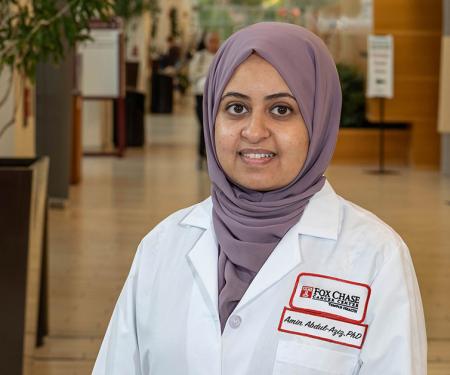
Amina Abdul-Aziz, PhD
Assistant Professor
Research Program
Lab Overview
The research program in the Abdul-Aziz lab focuses on understanding the molecular mechanisms involved in the aging bone marrow microenvironment (BMM) niche and the role of aged microenvironment cells in promoting adult myeloid leukemia development and response to therapy.
Using patient tumor cells and in in vitro as well as in vivo assays, the lab aims to uncover intrinsic mechanisms in the mesenchymal stromal cell and immune cell components of the BMM that are associated with natural and leukemia-induced aging.
The lab also places a large emphasis on investigating the effect of targeted leukemia therapies on components of the bone marrow microenvironment with the goal to understand mechanisms of resistance and relapse that are microenvironment driven.
Educational Background
- PhD, Biomedical Research, The University of East Anglia, Norwich, UK, 2018
- MSc, Oncology, The University of Nottingham, Nottingham, UK, 2011
- BSc, Pharmacy and Biotechnology, The German University in Cairo, Cairo, Egypt, 2010
Memberships
- European Hematology Association (EHA)
- American Association for Cancer Research (AACR)
- International Cell Senescence Association (ICSA)
- American Society of Hematology (ASH)
- American Aging Association (AGE)
Honors & Awards
- The NCI Pathway to Independence Award for Outstanding Early Stage Postdoctoral Researchers (K99/R00)
- The Ohio State University, Pelotonia postdoctoral fellowship
Research Interests
Abdul-Aziz Lab – Investigating leukemia promoting processes in the bone marrow microenvironment
Understanding aging processes (e.g. senescence and inflammation) in the bone marrow microenvironment of myeloid leukemias with the goal of identifying new therapeutic targets and biomarkers of response to therapy
- Investigating the effect of leukemia targeted therapies on components of the microenvironment with the aim to decipher mechanisms of resistance and relapse
Selected Publications
Additional Publications
Abdul-Aziz A, Devine RD, Lyberger JM, Chang H, Kovacs A, Lerma JR, Rogers AM, Byrd JC, Hertlein E, Behbehani GK. Mass Cytometry as a Tool for Investigating Senescence in Multiple Model Systems. Cells. 2023 Aug 11;12(16). doi: 10.3390/cells12162045. PubMed PMID: 37626855; PubMed Central PMCID: PMC10453346.
Abdul-Aziz AM, Sun Y, Hellmich C, Marlein CR, Mistry J, Forde E, Piddock RE, Shafat MS, Morfakis A, Mehta T, Di Palma F, Macaulay I, Ingham CJ, Haestier A, Collins A, Campisi J, Bowles KM, Rushworth SA. Acute myeloid leukemia induces protumoral p16INK4a-driven senescence in the bone marrow microenvironment. Blood. 2019 Jan 31;133(5):446-456. doi: 10.1182/blood-2018-04-845420. Epub 2018 Nov 6. PubMed PMID: 30401703; PubMed Central PMCID: PMC6356984.
Abdul-Aziz AM, Shafat MS, Sun Y, Marlein CR, Piddock RE, Robinson SD, Edwards DR, Zhou Z, Collins A, Bowles KM, Rushworth SA. HIF1α drives chemokine factor pro-tumoral signaling pathways in acute myeloid leukemia. Oncogene. 2018 May;37(20):2676-2686. doi: 10.1038/s41388-018-0151-1. Epub 2018 Feb 28. PubMed PMID: 29487418.
Abdul-Aziz AM, Shafat MS, Mehta TK, Di Palma F, Lawes MJ, Rushworth SA, Bowles KM. MIF-Induced Stromal PKCβ/IL8 Is Essential in Human Acute Myeloid Leukemia. Cancer Res. 2017 Jan 15;77(2):303-311. doi: 10.1158/0008-5472.CAN-16-1095. Epub 2016 Nov 21. PubMed PMID: 27872094.
Open Positions
About the Position
The Abdul-Aziz Laboratory is seeking ambitious and self-motivated Postdoctoral Fellows in Cancer Biology to join our efforts to further our understanding of the complex molecular mechanisms involved in the aging bone marrow microenvironment niche and its role in promoting adult myeloid leukemia development and response to therapy. The laboratory uses cutting-edge technologies and collaborations with leading scientists and clinicians to discover novel pathways and treatments for targeting adult leukemia and translate these advances into new treatments. Candidates should have a PhD degree or be close to obtaining their doctoral degree and should have a passion for science and desire to impact cancer. Advanced molecular biology skills and familiarity with cancer pathogenesis, cell-based therapy and knowledge of molecular/genetic concepts, experimental methods, and data analysis, and ability to maximize resources for troubleshooting pertaining to research activities are essential. Experience using mouse models is desired. Ability to plan, execute and analyze an independent research project is essential, as well as exceptional verbal and written communication skills. Preference will be given to self-motivated and career-oriented individuals.
About the Training Environment
At FCCC and Temple University, we provide a stimulating, supportive, and inclusive research environment. The Postdoctoral Research Associate will engage in federally funded (e.g. NCI/NIH) research projects. and be expected to engage in writing and publishing peer-reviewed manuscripts, presenting at scientific conferences, and gaining experience in grant writing. Considerable opportunities are available for professional development. The postdoc would also have the opportunity to contribute to the design and implementation of pilot projects and grant-funded studies, work directly on NIH grant applications, mentor research staff and students.
As one of the four original cancer centers to receive comprehensive designation from the National Cancer Institute, Fox Chase Cancer Center has been at the forefront of cancer research for almost 90 years. We are home to excellent research facilities, top clinicians and scientists, and outstanding patient care. Our singular focus on cancer, which couples discovery science with state of the art clinical care and population health, remains the foundation of our work.
The scientist training programs at Fox Chase Cancer Center provide professional development opportunities in four core areas identified as crucial for successful careers in science, research, and health care including communication, leadership, teaching, and mentorship. Upon joining the program, graduate students and postdocs develop individual development plans to help guide their growth. Training throughout the year is supplemented with free professional development opportunities, including a robust ‘How To’ series, writing courses, networking, mentorship, and teaching opportunities, a trainee-led seminar series, a trainee-led annual Research Conference, and more. Postdocs at Fox Chase Cancer Center are supported by the Temple University Postdoc Association and the Office of Academic Affairs at Fox Chase, and are compensated with competitive pay and benefits.
In addition to the robust training program, scientists at Fox Chase Cancer Center benefit from being part of the rich scientific and biotech environment in the Philadelphia region. Many of our former trainees are now employees (and contacts) at nearby institutions and companies, including The Wistar Institute, Merck, GSK, AACR, and numerous others.
How to Apply
Email a CV, cover letter that states research interest(s) and goals, and the name of at least three references to [email protected]. Qualified candidates will then be invited for a preliminary zoom interview.