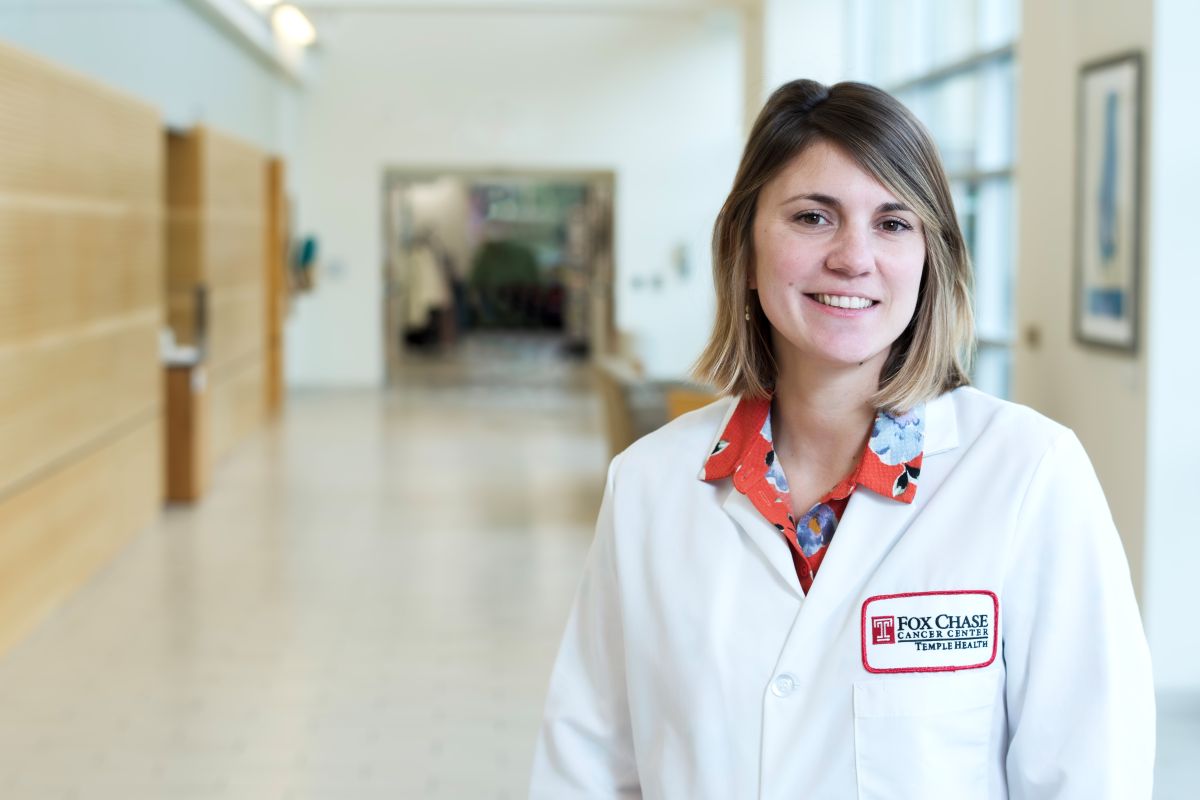
- The two-year fellowship supports Guilbaud’s research, which seeks to strengthen the immune system’s response to breast cancer following radiation therapy.
- Her work focuses on enhancing immune signals released by damaged cancer cells, with the goal of improving how radiation therapy helps the body fight cancer.
- Guilbaud credited Fox Chase’s postdoctoral training programs with helping prepare her for the competitive fellowship process.
PHILADELPHIA (March 9, 2026) — Emma Guilbaud, PhD, a postdoctoral fellow at Fox Chase Cancer Center, has been awarded a prestigious AACR-Incyte Immuno-oncology Research Fellowship.
“This award shows that leaders in the field believe in my work and its potential impact for patients. It gives me the support and confidence to continue this research and confirms that I am on the right path as a scientist.”
Prestigious Fellowship Supports Early-Career Cancer Researchers
The AACR-Incyte Immuno-oncology Research Fellowship is a highly competitive, two-year award that supports promising early-career scientists conducting innovative research at the intersection of cancer and immunology. The fellowship provides funding for salary support and research-related expenses and is designed to foster the development of the next generation of leaders in immuno-oncology research.
Guilbaud’s research is focused on improving the immune response of breast cancer tumors exposed to radiation therapy. Her work focuses on mitochondria, the energy-producing structures within cells.
Working to Improve How Patients Respond to Treatment
“When mitochondria are damaged by radiation therapy, mitochondrial DNA can be released, triggering immune-stimulating signals that are critical for anti-cancer immunity. My goal is to enhance this process to improve how patients respond to treatment,” said Guilbaud, a postdoctoral fellow in the laboratory of Lorenzo Galluzzi, PhD, an Associate Professor in the Cancer Signaling and Microenvironment Research Program.
To do this, Guilbaud is studying two main strategies. One approach uses venetoclax, a targeted therapy also known by its brand name, Venclexta, to make cancer cells more sensitive to radiation damage. The second blocks a natural cleanup process in cells that removes damaged mitochondria too quickly, allowing immune-stimulating signals to last longer.
The goal is to have these two strategies help the immune system better recognize cancer cells after radiation therapy and improve the body’s ability to fight the disease.
Highlighting Scientific Excellence
The fellowship application process required a detailed, multi-year research proposal outlining experimental methods and objectives, along with letters of recommendation and a personal statement describing long-term career goals.
Guilbaud credited Fox Chase’s postdoctoral training programs with helping prepare her for the competitive fellowship process. “Through mentorship, professional development courses, and guidance from other fellows, I was able to better understand the application process and strengthen my proposal.” She also expressed gratitude to Galluzzi and others in his lab for the support, dedication, and hard work that has been instrumental in her overall professional growth and success.
As part of the fellowship, Guilbaud will join the AACR research community and participate in AACR scientific meetings, providing opportunities for collaboration and continued professional growth.