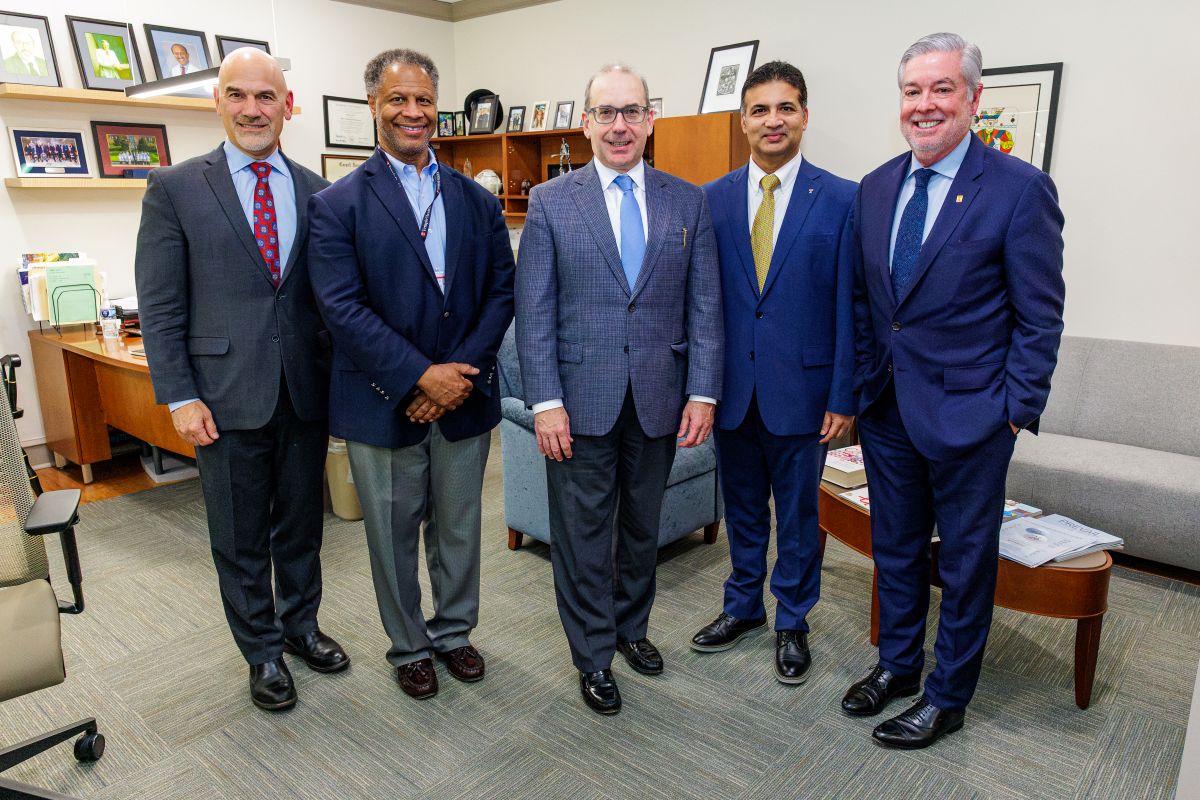
National Cancer Institute (NCI) Director Anthony Letai, MD, PhD, called on cancer centers to accelerate the opening of clinical trials and expand patient participation in research. He made his remarks during an October 15 visit to Fox Chase Cancer Center—Temple Health, where he also announced plans to incorporate clinical trial performance into the NCI's evaluation of its designated cancer centers.
Speaking to Fox Chase faculty, researchers, and staff at Reimann Auditorium, Letai outlined his priorities for advancing cancer research, including reducing barriers to clinical trials, expanding precision medicine beyond genetic testing, and translating scientific discoveries into more effective treatments for patients.
"Cancer centers are the arms and legs and eyes and ears of the national cancer program," Letai said, emphasizing the essential role of NCI-designated cancer centers in advancing research and bringing new treatments to patients.
Fox Chase Cancer Center, which in 2025 earned renewal of the prestigious core grant from the NCI, was one of the first institutions to receive cancer research funding from the NCI in 1962. Fox Chase was the first NCI designated comprehensive cancer center in Philadelphia, and has maintained continuous designation for more than 50 years.
Accelerating clinical trials and expanding patient access
A central theme of Letai's presentation was the need to shorten the time between the development of promising new cancer therapies and their evaluation in patients.
"We are too slow in the United States to activate trials," Letai said.
He noted that first-in-human clinical trials can begin substantially faster in countries such as Australia, creating incentives for biotechnology companies to conduct early-stage research overseas rather than in the United States.
To help address the problem, Letai said, the NCI plans to incorporate clinical trial performance metrics, including activation times, into its review of Cancer Center Support Grants, which provide critical infrastructure funding to NCI-designated cancer centers.
The goal, he explained, is to encourage institutions to identify and eliminate unnecessary delays that slow scientific progress and limit patient access to innovative treatments.
Letai also called for greater participation in clinical trials, noting that only a small percentage of U.S. cancer patients enroll in research studies. Expanding participation, he said, is essential to evaluating new therapies and ensuring that advances in cancer treatment reach more patients.
Robert A. Winn, MD, Cancer Center Director at Fox Chase, introduced Letai, highlighting his contributions to cancer research and his commitment to translating scientific discoveries into better patient outcomes. Winn also emphasized the alignment between Letai's priorities and Fox Chase's mission to advance cancer research while improving care in Philadelphia and beyond.
Moving beyond genetics in precision medicine
Letai outlined his vision for functional precision medicine, an emerging approach that seeks to identify effective cancer treatments by testing drugs directly against living tumor cells rather than relying exclusively on genetic sequencing.
Letai, whose research helped advance the development of the leukemia drug venetoclax, explained that traditional precision medicine has largely focused on identifying genetic mutations that can be targeted with specific therapies. Although this approach has produced important advances, many patients do not have mutations that point to an effective treatment.
"I think the job of precision medicine is to get the right drug to the right patient, to avoid futile therapy, and to maximize active therapy for cancer patients," Letai said.
Functional precision medicine offers another way to accomplish that goal. By exposing living tumor cells to different drugs and observing their responses, researchers may be able to identify promising treatments even when genetic testing does not reveal an obvious target.
Letai described three potential applications: discovering new treatments, predicting which drugs will work best for individual patients, and identifying patients most likely to benefit from therapies being evaluated in clinical trials.
He said the NCI is developing an internal laboratory dedicated to functional precision medicine and plans to support broader adoption of the approach at research institutions across the country.
Building on advances in cancer treatment
Throughout his presentation, Letai pointed to recent advances as evidence of the importance of sustained investment in basic and translational cancer research.
He highlighted progress in targeting RAS proteins, long considered among the most difficult cancer-related proteins to inhibit with drugs. New therapies targeting RAS mutations have shown encouraging results, including in pancreatic cancer, where treatment advances have historically been difficult to achieve.
Letai described these developments as examples of how discoveries supported by NCI funding can eventually lead to meaningful improvements in patient care, often after decades of research.
He also discussed the promise of therapeutic cancer vaccines, which are designed to stimulate the immune system to recognize and attack cancer cells. The NCI is participating in a public-private initiative to evaluate different vaccine technologies, with the goal of identifying approaches that could eventually be made available more broadly.
Supporting the next generation of cancer researchers
Letai addressed concerns about the future of federal research funding and emphasized the NCI's continued commitment to supporting scientific investigation.
He told the audience that the institute distributed approximately $5.6 billion in extramural research funding in fiscal year 2026, exceeding the previous year's record despite administrative and funding challenges.
During a question-and-answer session, Letai encouraged early-career investigators to remain optimistic about their opportunities, pointing to advances in genomic sequencing, artificial intelligence, and imaging technologies that have transformed the possibilities for scientific discovery.