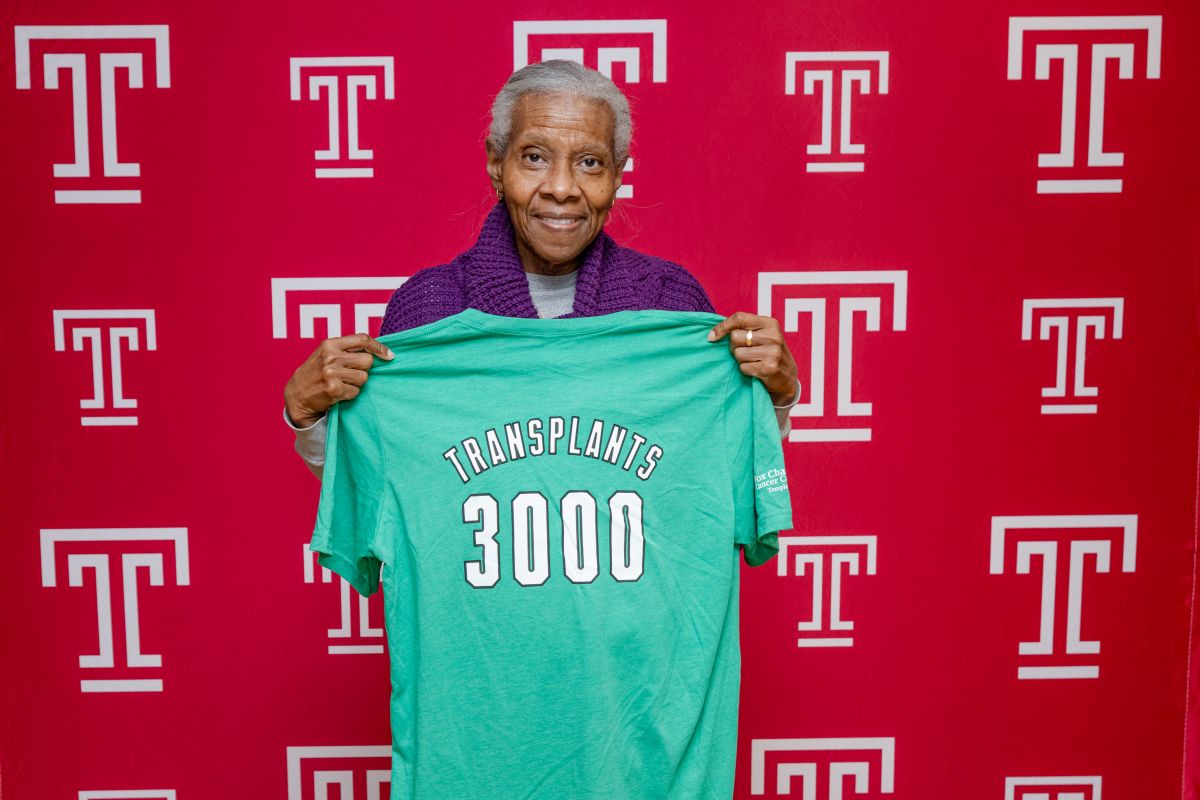
By all accounts, Regina Evans should not have been able to walk.
A mass was wrapped around her spine. Most of her vertebrae had collapsed. When doctors reviewed her scans, they were surprised she was still on her feet.
Regina remembers it differently.
"That was the hand of God holding me together," she said.
Her story helps explain what the program’s 3,000 bone marrow transplants truly represent. The milestone is more than a number; it reflects thousands of patients and families who entrusted their care to the program over the years.
A Life Saved by Many Hands
Regina shared her experience during a celebration of the 3,000th bone marrow transplant at the TUH–Jeanes Campus. She spoke as one of many patients whose journeys helped define the milestone.
Her story began in 2014, when she noticed a change in the way she walked.
"What brought me to the doctor wasn't pain. It was my balance," she said. "I started walking sideways like a crab. That led me to a scan that changed everything."
Days later, on her mother's birthday, Regina underwent a 16-hour spine surgery conducted by Dr. Bong-Soo Kim, a neurosurgeon at Temple. By the next morning, she was walking the halls.
"I knew I was in good hands," she said.
Around that time, she was diagnosed with multiple myeloma.
More surgeries followed, along with a stem cell transplant under the care of Henry Fung, MD, FACP, FRCPE, Chair of the Department of Bone Marrow Transplant and Cellular Therapies. When the cancer returned aggressively, a clinical trial provided another chance.
Through every step, Regina said, the team never gave up. "You watched me closely. You explained everything. You believed in my future."
Today, Regina is in complete remission.
"Fox Chase didn't just treat my cancer," she said. "You treated me."
The Meaning of 3,000 Transplants
"When people hear 3,000 transplants, they think about scale," Fung told the audience. "But this milestone is about 3,000 human stories — 3,000 families who faced fear, uncertainty, and hope."
Bone marrow transplantation remains one of the most demanding treatments in oncology. Every patient brings risk. Every family carries uncertainty. And not every story ends the way Regina's did.
"We also pause today to remember the patients we lost along the way," Fung said. "It was our privilege to stand beside them with compassion, dignity, and hope."
Looking ahead, he emphasized how the program continues to evolve, building on its transplant foundation while expanding access to cellular and immunotherapies, including CAR T-cell therapy, often through clinical trials.
"Our goal has always been to combine high-quality care with innovation," he said. "That's how we continue to serve patients today and improve care for those who will come after them."
A Team Built for the Hardest Moments
This milestone belongs to far more than physicians.
“Programs like this succeed because highly skilled people across disciplines and organizations that come together around a shared mission,” said Abhi Rastogi, MBA, MIS, President and CEO of Temple Health. “This program reflects the very best of what collaboration between Fox Chase and Temple Health can achieve.”
The program itself is a unique collaboration among Temple Health, Temple University Hospital–Jeanes Campus, and Fox Chase Cancer Center. Patients now travel from more than 25 states, choosing the program not for convenience, but for trust.
More Than Transplant: A Future of Innovation
Over nearly four decades, the program has grown alongside the science. What was once considered a last-resort therapy has become a cornerstone of modern cancer care.
"You're not just pushing bone marrow transplant forward," said Robert Uzzo, MD, MBA, FACS, President and CEO of Fox Chase Cancer Center. "You're advancing cellular therapies, CAR T-cells, immunotherapy, clinical trials, and changing what's possible for patients."
That evolution is reflected in the department's new name: the Blood Cancer and Cellular Therapy Institute, a title that captures both the precision of the science and the humanity behind it.
Still Walking
Regina closed the event with words that lingered long after the applause.
"Because of you — all of you — I'm still walking. Still living. Still praising God," she said.
"And I'm not done yet."