Being diagnosed with lung cancer can be unsettling, and it can leave you with dozens of questions. What is lung cancer? What happened in my body? How did I develop this condition? To learn more about your diagnosis, it helps to understand how lung cancer develops.
The body is composed of trillions of cells. As aging cells die, new ones form and divide to create more cells to replace the ones that died.
A cancer diagnosis means that this process has gone awry. Old, aging cells aren’t dying off when they should, and new cells are forming when they shouldn’t. These excess cells can form tumors and spread into surrounding tissues.
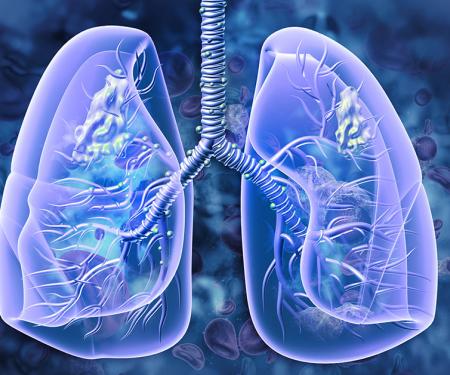
The lungs are cone-shaped organs in your chest. When you inhale, air enters your lungs through the trachea (windpipe). Like a tree, the bronchi branch into smaller tubes called bronchioles. At the end of the bronchioles are small air sacs called alveoli. This is why lung cancer usually starts when a mass of cells grows out of control in the bronchi, bronchioles, or alveoli.
There are two major types of lung cancer:
- Non-small cell lung cancer (NSCLC), which occurs in 85%– 90% of all cases
- Small cell lung cancer (SCLC), an aggressive cancer that occurs in just over 10% of all lung cancer cases
What Is Non-Small Cell Lung Cancer (NSCLC)?
There are several types of non-small cell lung cancer, with each type growing and spreading in a different way. The types of non-small cell lung cancer are named for the kinds of cells found in the cancer and how the cells look under a microscope:
- Squamous cell carcinoma: Cancer that begins in squamous cells, which are thin flat cells that look like fish scales. They line the inside of the bronchi (main airways) into the lungs. This type of cancer is also called epidermoid carcinoma.
- Large cell carcinoma: Cancer that may begin in several types of large cells. It was given this name because the abnormal cells appear large under a microscope.
- Adenocarcinoma: Cancer that begins in the cells that line the alveoli and make substances, such as mucus.
- Other less common types of non-small cell lung cancer are pleomorphic, carcinoid tumor, salivary gland carcinoma, and unclassified or undifferentiated carcinoma.
Your risk of developing non-small cell lung cancer increases if you:
- Are a longtime or former smoker
- Have been exposed to secondhand smoke, or
- Have had environmental or occupational exposure to radon, asbestos, uranium, and other substances.
What Is Small Cell Lung Cancer (SCLC)?
In small cell lung cancer (SCLC), small cancerous cells arise in the airway, usually in a central location. This is an aggressive cancer that spreads quickly throughout the body, through the blood and lymphatic (lymph node) systems. Typically occurring in people who smoke or who used to smoke, SCLC accounts for just over 10% of all lung cancers.
Each type grows and spreads in different ways. The types of small cell lung cancer are named for the kinds of cells found in the cancer and for how the cells look when viewed under a microscope.
Is Mesothelioma a Type of Lung Cancer?
Malignant pleural mesothelioma is sometimes referred to as lung cancer, but it is not. These cancer cells form on the thin layer of tissue (mesothelium) that covers the pleura, the lining of the chest cavity containing the lungs.
This disease develops years after a patient breathes in asbestos fibers—fibrous partials that were once widely used in insulation and other commercial products. Although it is not a lung cancer, mesothelioma can cause lung pain and breathing difficulties.
Lung Cancer Symptoms
Both major types of lung cancer have similar symptoms, which often include a cough that doesn’t go away and shortness of breath. However, lung cancer sometimes does not cause symptoms. Instead, it may be found during a chest X-ray performed for another condition, such as pneumonia.
The symptoms below can be signs of lung cancer, but they can also indicate a different condition. Please consult with your physician if you are showing any of the following symptoms:
- Chest discomfort or pain
- A cough that doesn’t go away or gets worse over time
- Trouble breathing or wheezing
- Blood in sputum (mucus coughed up from the lungs)
- Hoarseness
- Loss of appetite
- Weight loss for no known reason
- Tiredness/lethargy
- Trouble swallowing
- Swelling in the face and/or veins in the neck
Risk Factors: What Causes Lung Cancer?
In most cases of cancer, researchers haven’t yet identified the exact reason behind the abnormal cell division process. However, researchers have pinpointed risk factors that are worth being aware of:
- Smoking cigarettes, pipes, or cigars, now or in the past. This is the most important risk factor for lung cancer. The earlier in life a person starts smoking, the more often a person smokes, and the more years a person smokes, the greater the risk of lung cancer.
- Being exposed to secondhand smoke.
- Being exposed to radiation from any of the following:
- Radiation therapy to the breast or chest
- Radon in the home or workplace
- Imaging tests, such as CT scans
- Atomic bomb radiation
- Living where there is air pollution.
- Having a family history of lung cancer.
- Being infected with the human immunodeficiency virus (HIV).
- Taking beta carotene supplements and being a heavy smoker.
- Older age is the main risk factor for most cancers because the chance of getting cancer increases as you get older.
- For non-small cell lung cancer only—being exposed to asbestos, chromium, nickel, beryllium, arsenic, soot, or tar in the workplace.
When smoking is combined with other factors, your risk of developing lung cancer is increased.
I’m Smoking, and I’d Like to Stop
Cigarette smokers are 15 to 30 times more likely to develop lung cancer than non-smokers are. Fox Chase offers a smoking cessation program that assists patients using tobacco products and those who have used tobacco within the past year. If you join this program, you will get counseling along with nicotine replacement therapy or other medications. For more information, call 888-369-2427.
But I Never Smoked…
While smoking is a major risk factor, never smokers develop lung cancer as well. In fact, 20% who are diagnosed every year with non-small cell are never smokers. These situations require different treatment strategies. Researchers are investigating potential causes. For example, in one study of non-smokers with lung cancer, Fox Chase Cancer Center researchers found that 6% of the patients showed signs of being infected by a strain of human papillomavirus (HPV) known to cause cancer.
Also, never smokers can develop lung cancer by inhaling secondhand smoke—smoke given off by other people’s cigarettes. Other causes can include gene mutations or workplace toxins, such as diesel exhaust.
Fox Chase Research Identifies a Clue about Lung Cancer in Non-smokers
A study by Fox Chase researchers found a link between estrogen and lung cancer in people who have never smoked. Estrogen, a hormone, can break down into substances called metabolites. Some can cause cancer. Fox Chase researchers found that some of those cancer-causing metabolites can settle in the lungs.
This research could help explain why people who have never smoked also develop lung cancer, even though smoking is the number-one risk factor.
In the study, estrogen metabolites were detected within the lungs of individuals, but women had higher levels, the researchers found. Among people who had never smoked, researchers compared the level of these cancer-causing metabolites in the lungs of Chinese-American women to non-Hispanic white American women.
“Chinese-American women produced more of the ‘cancer-causing’ estrogen than non-Hispanic white women, which makes sense, as Chinese never-smoking women have much higher rates of lung cancer than never-smoking European and Caucasian women,” said Jing Peng, PhD, lead author of the study.
Moving forward, the researchers will determine whether blocking the pathways that allow the production of “bad” estrogen metabolites in the lung will reduce the incidence of cancer.
Worldwide, about 15% of men and 50% of women with lung cancer have never smoked.
“Our finding underscores the importance of understanding and treating lung cancer as a disease with more than one cause,” said Margie Clapper PhD, deputy scientific director, co-leader of the Cancer Prevention and Control Program at Fox Chase, and senior author of the study. “While it is true that smoking tobacco is the top risk factor for lung cancer, a substantial number of people receive a diagnosis despite having never smoked.”
Learn more about clinical trials at Fox Chase.
Never Smokers Lung Cancer Clinic at Fox Chase
Fox Chase’s Never Smoker Lung Cancer Clinic offers standard of care treatments and clinical trials for lung cancer patients who have never smoked or have a light smoking history.
Our pulmonologists and surgical, medical, and radiation oncologists work with researchers to identify possible risk factors for lung cancer in never smokers, develop better screening and treatment options, and address the specific treatment needs of these patients.
The clinic is open to individuals who:
- Have never smoked or have a very light smoking history (less than 100 cigarettes in their lifetime)
- Have a lung cancer that is positive for a driver mutation such as EGFR, ALK, or ROS1
“Our new clinic specifically addresses the needs of people who have never smoked, which is important because they need different treatments,” said Joseph Treat, MD, a medical oncologist and a professor in the Department of Hematology/Oncology at Fox Chase.
“Many have certain mutations, such as EGFR – a common mutation seen in never-smokers – that tend to be responsive to particular treatments but not to others, such as immunotherapy,” Treat said.
Together surgical, medical, and radiation oncologists, as well as pulmonologists, work with researchers like Clapper and Peng in a multidisciplinary approach to identify possible risk factors for lung cancer, and develop better screening and treatment options. In addition to providing support, the new clinic aims to enroll patients in Clapper’s ongoing clinical research studies.
“This is just one foundational approach we are looking into at Fox Chase,” Treat said. “We have good treatment options for never-smokers who develop lung cancer and, with our new lung cancer clinic for never-smokers, we plan to develop additional strategies.”